


3. Technical specifications#
The following table lists the main technical specifications of the MCS500 robot arm.
Characteristics |
Value |
|---|---|
Position repeatability |
0.005 mm |
Rated payload |
0.5 kg |
Weight of robot arm |
4.3 kg |
Mounting orientations |
tabletop or upside down |
Range for joint 1 |
[−140°, 140°] |
Range for joint 2 |
[−145°, 145°] |
Range for joint 3 |
[−102 mm, 0 mm] |
Range for joint 4 |
[−3,600°, 3,600°] |
Maximum speed for joint 1 |
300°/s |
Maximum speed for joint 2 |
500°/s |
Maximum speed for joint 3 |
700 mm/s |
Maximum speed for joint 4 |
5,000°/s |
Input voltage |
36 V (DC) |
Maximum / peak input current |
12 A / 16.67 A |
Operating ambient temperature range |
[5°, 35°] |
Operating ambient relative humidity range |
[10%, 80%] (non-condensing) |
Airborne noise level |
75dB (only when the robot is moving fast; when it is immobile, the noise is barely perceptible) |
Maximum operating altitude |
2000 m |
Robot body material |
Anodized aluminum alloy |
IP rating |
IP 40 |
The following figure shows all important dimensions of the MCS500. Recall from Section 1 that all joints are at zero in the configuration shown below.

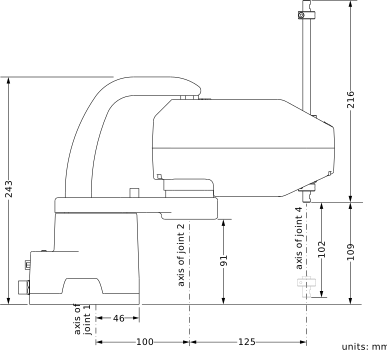
Figure 18 The principal dimensions and offsets of the MCS500 robot#
Additionally, the schematic below illustrates a top view of the MCS500 workspace, specifically for an end-effector whose origin is located on the axis of the spline shaft. It is important to note that most reachable end-effector positions can be achieved with two different robot configurations: one commonly referred to as “lefty” and the other as “righty.” This topic is discussed in more detail in the Programming Manual.

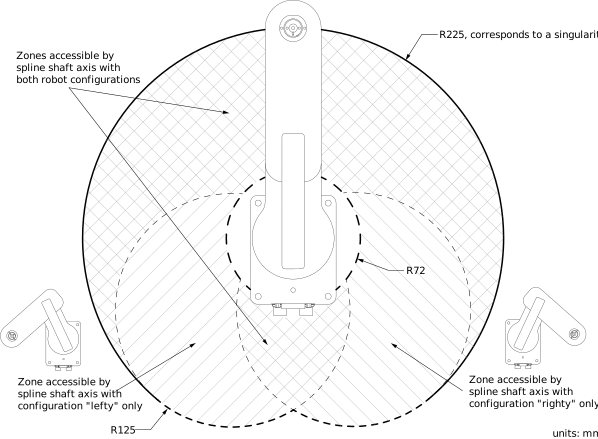
Figure 19 The working range of the MCS500 robot#
The CAD files of the MCS500 robot arm and of the MSIPS module (in STEP format) can be downloaded from here. You can also use one of several robot simulation and offline programming software packages that include a model of our Meca500, including Visual Components and RoboDK. Note that we also offer a Mecademic-only version of RoboDK, for exclusive use with our robots.
The table below lists the technical specifications for the MSIPS-R1 module. As already mentioned, the MSIPS module has an IEC C14 connector that accepts an AC power cord with three-prong IEC C13 connector on one end, and your own country’s power plug on the other. You can connect this power cord to any AC source that supplies voltage between 90 V and 250 V at frequency between 50 Hz and 60 Hz.
Characteristics |
Value |
|---|---|
Weight |
1.3 kg |
Mounting orientations |
any |
Input voltage range |
[90 V, 250 V], AC, single phase |
Input frequency range |
[50 Hz, 60 Hz] |
Maximum input current |
8 A at 110 V |
Input power connector |
IEC C14 |
Power factor |
0.99 @ 115 V (AC) |
Maximum power output |
432 W @ 5% (DC) |
System grounding type |
TN |
Operating ambient relative humidity range |
[10%, 80%] (non-condensing) |
Maximum operating altitude |
2000 m |
Robot body material |
Anodized aluminum alloy |
IP rating |
IP 40 |
Warning
We recommend that you use a surge protector when connecting the MSIPS module to an AC power source.
Finally, the requirements for the I/O connections on the MSIPS module are provided in the following table. Further details will be provided in Section 2.3.2.